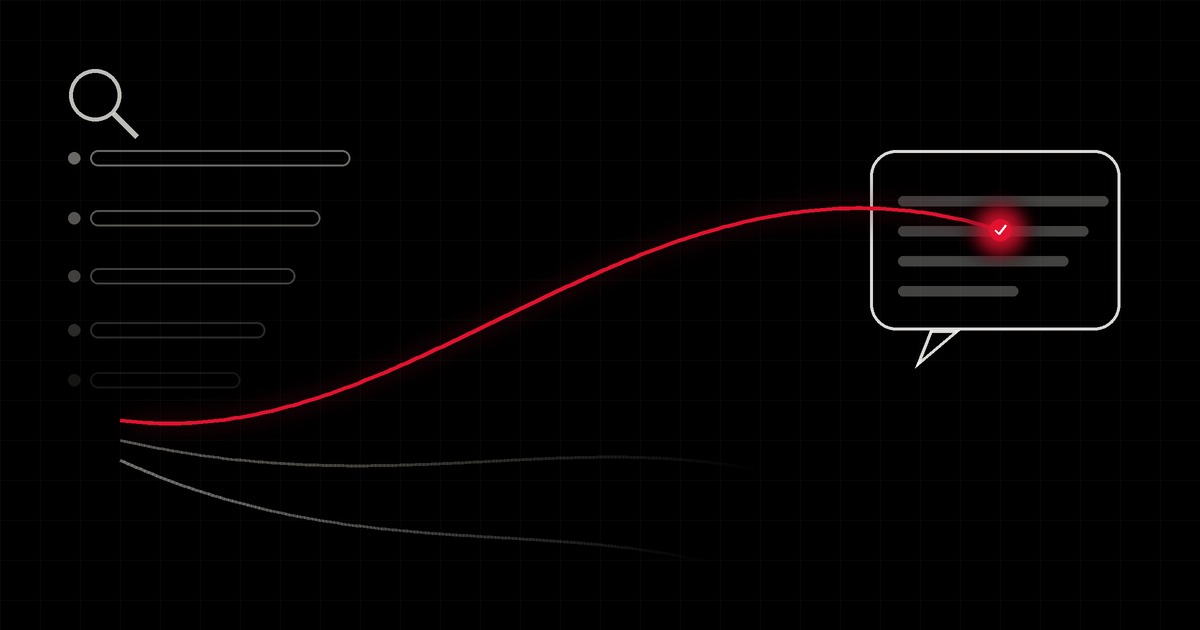
For twenty years, the goal of any search strategy was the same: rank high enough to earn the click. In 2026 that logic no longer explains what's actually happening. More and more searches are now resolved directly inside the answer from ChatGPT, Gemini, Perplexity, or Google's AI Overview, without the user ever visiting a website. The game is no longer played in the ranking alone: it's played in whether your brand is the one the AI decides to cite.
What the data actually says (without overstating it)
It's tempting to quote one single, dramatic "zero-click" number for 2026, but the reality is more nuanced, and it deserves the same rigor we'd apply to measuring any campaign. The most solid and recent data point comes from a Pew Research study from July 2025 on real browsing behavior: in visits where Google showed an AI-generated summary, traditional result links were clicked in only 8% of cases, versus 15% when no AI summary was shown. And of the visits that did show a summary, only about 1% resulted in a click through to one of the sources cited inside that summary.
In other words: the AI summary doesn't just reduce clicks to regular results, it also sharply reduces clicks to the very sources it cites. Being mentioned is no longer an automatic springboard to traffic. Increasingly, it is the final destination of the search itself.
Why this changes the goal of the strategy
If users rarely click even when your brand is cited, measuring success by organic traffic alone no longer tells the whole story. The citation itself has value: it builds brand authority, influences the purchase decision before any visit exists to track, and in many cases replaces the traditional search entirely in the user's mind. Brands that only optimize for the click will see their metrics drop without understanding why. Brands that understand GEO (Generative Engine Optimization) as the discipline built precisely for this will keep growing even as "old-school" traffic shrinks.
What this means in practice
Adapting your strategy doesn't mean abandoning SEO, it means expanding it. Here's what actually changes:
- Content structured to be extracted, not just read: direct answers, concrete data, and clear headings are what a generative engine can lift and cite. Ambiguous or purely narrative content gets left out.
- Topic over exact keyword: generative engines understand intent and context, not just text matches. Covering a topic in depth outweighs repeating a keyword.
- Brand mention as the new ranking metric: without a traditional "top 10" inside an AI answer, what matters is whether you're cited at all. Tracking how often and in what context your brand is mentioned inside AI answers is now as relevant an analytics task as classic rankings.
- Platform loyalty: just as there were Google users versus Bing users, there are now users who trust ChatGPT more, others Gemini, others Perplexity. Each platform cites differently, so a real GEO strategy doesn't target just one engine.
What this means for your business
If your analytics only measure sessions, clicks, and Google rankings, you currently have an incomplete picture of how much real demand you're capturing. Part of that demand is already being resolved with zero clicks, inside a conversation with an AI, and right now that part of the funnel is nearly invisible unless you measure it specifically. The good news is it's still early: most companies haven't adapted their content or their measurement to this reality yet, which leaves a real window open for whoever moves first.
At Undercut we don't sell the promise of "getting into ChatGPT" as some magic trick. We treat it for what it is: a measurable discipline, with its own metrics and its own process, every bit as serious as the technical SEO that's been working for twenty years. The difference is that, this time, whoever moves first has a lot less competing noise to cut through.